
Aeris Round Polarized Magnetic Prescription Sunglasses: Complete Guide to Magnetic Eyewear Innovation
Tired of switching between glasses? Discover how Aeris Round Polarized Magnetic Prescription Sunglasses combine adjustable ND lenses, polarization, and magnetic convenience in one $37.99 frame. Learn if they're right for you.
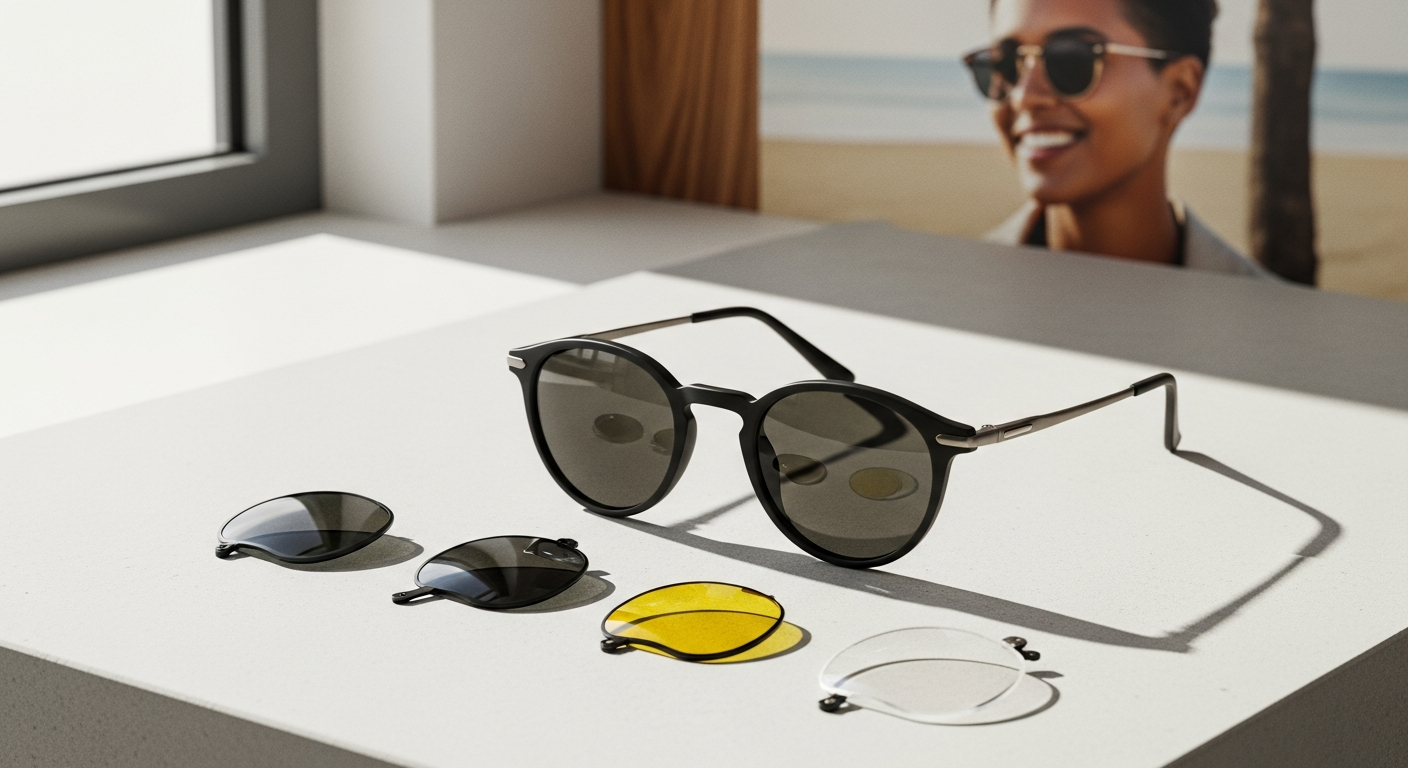
The Morning You Forgot Your Sunglasses Again
Step outside on a bright morning, and the realization hits instantly: sunglasses at home. For people with prescriptions, this scenario repeats constantly. One pair handles indoor work. Another tackles sunny afternoons. A third sits in the car for driving. That's three separate purchases, three different frames competing for space, and three ways to lose or damage expensive eyewear. The financial toll climbs quietly—replacement costs, frames that don't quite match your style, the general friction of managing an eyewear collection instead of just wearing glasses.
The Aeris Round Polarized Magnetic Prescription Sunglasses from Elklook approach this problem differently. Instead of accumulating pairs, you attach a magnetic sunglass layer to your prescription base, switching between clear vision and glare-free clarity in seconds. The ND (Neutral Density) adjustable light reduction feature means you're not stuck with one fixed tint—you control the darkness based on actual conditions. This isn't incremental innovation. It's a genuine rethinking of how prescription eyeglass wearers interact with their eyewear throughout the day.
Discover how the Aeris magnetic system simplifies your eyewear routine.
The Magnetic Prescription Eyewear Revolution: Why One Frame Beats Multiple Pairs
How magnetic attachment technology eliminates the need to purchase separate prescription sunglasses
Traditional prescription sunglasses require a separate frame and lens prescription. You're essentially buying two complete pairs of glasses—one for indoors, one for outdoors. The Aeris eliminates this duplication through magnetic attachment. Your prescription base frame stays consistent. A polarized magnetic layer snaps onto the front, creating a functional sunglass setup without needing a second prescription ground into separate lenses. When you head back inside, you remove the magnetic layer in one motion. The frame underneath continues to function perfectly as regular prescription glasses.
This design avoids the optical issues that plague clip-on sunglasses, where attachment points can distort the visual field or create weight imbalances. Magnetic systems distribute force evenly across the frame front, maintaining optical integrity while providing secure attachment.
The convenience factor: snap-on/snap-off functionality for busy lifestyles
Manual dexterity matters less than you'd expect. Magnetic attachment requires minimal effort—align the magnetic layer with the frame and let physics do the work. No threading clips, no twisting mechanisms, no alignment fussiness. The entire transition takes three seconds. For people moving between car and office repeatedly, or outdoor work punctuated by indoor tasks, this speed matters tangibly.
Busy professionals notice the difference immediately. No more setting down glasses and forgetting them. No more pulling out two separate pairs and managing which one goes where. One frame, two configurations.
Cost savings compared to buying traditional prescription sunglasses separately
Prescription sunglasses from major retailers run $150–$300 when you factor in frame plus prescription lenses. The Aeris base frame costs $37.99. Adding prescription lenses through Elklook's process costs considerably less than obtaining a separate prescription sunglasses pair from traditional optical shops. You're consolidating into a single frame with interchangeable components rather than duplicating the entire purchase.
Even accounting for the magnetic sunglass layer, the total investment stays substantially below the cost of two complete prescription pairs. The mathematics strongly favor this approach for people serious about reducing eyewear expenses.
User experience benefits of seamless transitions between indoor and outdoor wear
Friction reduction shapes daily experience more than people realize. Each time you switch eyewear, you lose five seconds of productivity. You risk damaging glasses through careless placement. You occasionally grab the wrong pair and realize mid-drive that you're wearing your indoor frames in bright sun. The Aeris removes all these micro-frustrations.
The seamless transition creates a psychological shift too. Instead of viewing sunglasses as optional accessories, they become integrated into your normal vision system. You don't "choose" to put on sunglasses anymore—you configure your eyes for the environment.
Why busy professionals and active individuals are gravitating toward this design
Professionals moving between climate-controlled offices and bright outdoor environments experience dramatic lighting changes repeatedly throughout the day. The Aeris magnetic system accommodates this better than photochromic lenses, which respond slowly to light changes. Athletes appreciate the quick swap capability during training that transitions between gym and outdoor work. Commuters benefit from glare reduction during drives without managing a separate pair specifically for road use.
Active individuals particularly value the security of magnetic attachment. Traditional clip-on systems can accidentally dislodge during movement. Magnetic systems stay attached through running, cycling, and general athletic activity.
The environmental advantage of reducing eyewear waste through single-frame solutions
Manufacturing multiple pairs multiplies material waste. Frames, lenses, coatings, and packaging multiply for each pair. A single adaptable frame with interchangeable components reduces manufacturing impact compared to producing separate prescription and sun pairs. For environmentally conscious consumers, the Aeris approach aligns personal convenience with reduced resource consumption.
This sustainability angle gains relevance as eyewear companies face increasing pressure around manufacturing practices. Buying one frame instead of two genuinely matters at scale.
Understanding ND Adjustable Light Reduction: Beyond Standard Polarization
What ND (Neutral Density) filters actually do and how they differ from fixed tints
Neutral Density filters reduce light intensity uniformly across the visible spectrum without altering color. Traditional sunglasses apply a fixed tint—you get one darkness level regardless of conditions. ND adjustable systems let you manually increase or decrease the tint intensity, controlling how much light reaches your eyes.
This distinction separates casual sunglasses from precision eyewear. Fixed tint sunglasses perform reasonably on bright days but become useless on overcast mornings or during evening commutes. ND adjustable lenses adapt to the actual conditions present at that moment.
Manual light control: adjusting tint intensity based on real-time lighting conditions
The Aeris uses a manual adjustment mechanism rather than automatic darkening. You physically control the tint level by rotating or adjusting the lens mechanism. This puts you in command rather than relying on electronic sensors or chemical reactions. On a bright morning, you increase tint. As clouds arrive, you decrease it. Heading indoors, you remove the sunglass layer entirely.
Manual control has advantages. No waiting for automatic systems to respond. No batteries or electronics to fail. No sensitivity to window tinting or windshield coatings that confuse photochromic lenses. You adjust darkness on your schedule, not based on algorithms.
Polarization benefits: glare reduction on water, snow, and reflective surfaces
Polarization specifically targets reflected light by blocking horizontally-oriented light waves. This eliminates glare bouncing off water, snow, and pavement—the precisely the scenarios where standard sunglasses fail most noticeably. A driver facing afternoon sun reflecting off wet roads experiences dramatic clarity improvement with polarized lenses.
The Aeris combines both polarization and ND adjustment. You get glare reduction plus the ability to control overall brightness. Water activities particularly benefit—polarization cuts water glare while ND adjustment handles varying sunlight intensity throughout the day.
The science behind why adjustable tint outperforms one-size-fits-all sunglasses
Light conditions change constantly. Early morning sun differs from midday sun differs from late afternoon sun. Cloud cover, reflective surfaces, and geographic location all modify actual light intensity reaching your eyes. A single fixed tint becomes a compromise—adequate in some conditions, insufficient in others, excessive in still others.
Adjustable tint systems optimize for current conditions rather than averaging across multiple scenarios. Research on visual comfort consistently shows that users report less eye strain when able to adjust tint to match actual lighting rather than accepting a fixed level. The science supports what users experience intuitively.
Ideal scenarios where ND adjustment makes the biggest difference
Situations with dramatic lighting variation benefit most. Extended outdoor work where conditions change throughout the day. Driving that encompasses both morning commutes and afternoon sun. Water sports where reflection changes with water surface conditions. Photography, where precise light control affects what you can perceive. Hiking where altitude and cloud cover create constantly shifting conditions.
Conversely, ND adjustment provides less benefit for people who spend most time in stable conditions—someone working permanently indoors with just brief outdoor breaks probably doesn't need adjustable tint.
How the combination of polarization + ND creates superior visual clarity
Separately, each technology addresses specific visual problems. Together, they create a comprehensive solution. Polarization handles reflected glare. ND adjustment handles overall brightness. A driver on a sunny day over wet roads encounters both problems simultaneously—polarization eliminates water glare while ND adjustment prevents eye strain from excessive brightness.
This combination explains why the Aeris stands out. Single-feature sunglasses solve part of the problem. The dual-technology approach solves multiple problems simultaneously, delivering superior actual visual experience.
Experience the difference that adjustable light reduction makes in your daily vision.
Comparing adjustable tint technology to photochromic (transition) lenses
Photochromic lenses darken automatically based on UV exposure. They sound appealing but carry practical limitations. Darkening and lightening takes 15–30 minutes. They don't work well inside cars because windshields block much UV light. They perform inconsistently in cold weather. They gradually wear out, requiring replacement every few years.
Adjustable ND systems respond instantly to your control. They work inside cars. They don't degrade with age. They cost less than quality photochromic lenses. The tradeoff is that they require active adjustment rather than automatic response—but for most users, this proves simpler and more reliable than waiting for chemical reactions to complete.
Round Frame Design: Classic Aesthetics That Actually Work for Most Faces
Why round frames have become a modern staple despite their vintage origins
Round frames emerged decades ago and faded from mainstream eyewear for years. Contemporary fashion gradually rehabilitated them, and now they're arguably the dominant frame shape across style-conscious eyeglass wearers. This resurgence happened because round frames genuinely suit broad face shape ranges, and their aesthetic strikes a balance between retro appeal and contemporary minimalism.
The shape avoids the aggressive angles of rectangular frames or the ultra-specific niche appeal of cat-eye designs. Round frames say "thoughtfully chosen" without requiring particular face geometry or fashion commitment.
Face shape compatibility: which profiles benefit most from round geometry
Round frames work well with most face shapes. Angular faces benefit from the softening effect of curves. Longer faces gain visual balance from the frame's width. Square jaws appear less harsh against rounded edges. Only extremely wide faces sometimes clash with round frames, which lack the horizontal emphasis those proportions need.
This broad compatibility explains the frame's popularity. It's the closest eyewear comes to a one-size-fits-most solution while still looking intentional rather than generic.
The Aeris aesthetic: balancing retro appeal with contemporary eyewear trends
The Aeris doesn't overcommit to vintage recreation. It uses round geometry as foundation but executes it with modern sensibilities—clean lines, contemporary materials, contemporary proportions. The result feels current rather than costume-like. This balance matters for people wanting round frames without appearing to deliberately adopt a retro aesthetic.
The round shape also provides visual softness that photography-conscious users appreciate. Round frames photograph better than many angular alternatives, particularly in professional and social contexts.
How round frames compare to aviator, rectangular, and cat-eye alternatives
Aviators project aviator-specific identity and suit narrower face ranges. Rectangular frames suit angular faces but can feel corporate depending on execution. Cat-eye frames require confident styling commitment and suit specific face shapes. Round frames function as the diplomatic option that works broadly and reads as thoughtfully chosen without extreme styling statement.
For prescription eyeglass wearers primarily concerned with vision rather than fashion identity, round frames offer safety. They'll look reasonable in most contexts, on most faces.
Versatility across different settings: professional, casual, athletic
Round frames transition across contexts better than highly specific shapes. They look appropriate in professional environments without appearing fashion-forward or trendy. They work for casual wear. Athletic contexts present interesting challenges—large round frames can shift during movement—but moderate-sized rounds manage activity adequately.
This versatility matters for people buying a single pair. The frame needs to function across multiple life contexts rather than specializing in one.
The psychological appeal of timeless design in eyewear choices
Eyeglass purchases carry inherent uncertainty. You're committing to looking at something every day for potentially years. Timeless designs reduce this anxiety. Round frames have survived aesthetic cycles. They're unlikely to suddenly feel dated. This psychological security matters for a purchase this personal and visible.
Conservative choices work better for prescription eyewear than for fashion-forward accessories. People want their glasses to feel reliable and stable, not trend-dependent.
Personal styling considerations when choosing round prescription frames
Face shape remains primary. Consider current frame size trends—modern round frames tend toward moderate sizes rather than extremely large vintage styles. Think about material and color choices within the round frame category. Metal rounds project different aesthetics than plastic rounds. Consider how the frame interacts with your hair color and skin tone.
Actual aesthetic experience matters more than abstract rules. Try on round frames and assess whether they genuinely feel like you rather than selecting based on shape geometry alone.
Breaking Down the $37.99 Price Point: Where Budget Meets Innovation
The original $94.98 price versus current markdown: what changed?
The substantial discount raises natural questions. The original $94.98 price reflected standard eyewear retail markups. The current $37.99 appears to represent aggressive discounting rather than a permanent price change. Possible explanations include inventory clearance, competitive response to market pressure, or strategic pricing to drive volume sales.
Understanding discount origins matters for expectations. Discounted pricing often correlates with strong product satisfaction—companies aggressive about volume typically start with solid products. Conversely, clearance pricing sometimes signals quality concerns. The Aeris's 20K+ monthly sales suggest the former rather than the latter.
Material quality assessment: TR90 and metal construction at this price tier
TR90 is a lightweight thermoplastic known for durability and flexibility. Metal frames at this price typically use aluminum alloys rather than premium materials. Both materials perform reasonably at the $37.99 price point—they're not luxury materials, but they're functional and durable enough for daily wear.
The combination of TR90 and metal (likely arm materials) suggests a hybrid approach designed to balance flexibility with structural integrity. This construction approach makes sense for a frame needing to accommodate magnetic attachments.
Feature-to-cost ratio: ND adjustment + polarization + magnetic system under $40
Evaluating value requires comparing what you get at $37.99 to what similar features cost elsewhere. ND adjustable sunglasses typically cost $80–$150. Polarized prescription sunglasses run $150+. Magnetic eyewear systems add $20–$50. The Aeris bundles all three at less than any individual premium option.
This feature concentration at the given price point genuinely stands out. You're not getting luxury materials, but you're getting legitimate advanced functionality at accessible pricing.
How Aeris pricing compares to competitors offering similar functionality
Direct competitors offering magnetic prescription systems are limited. Warby Parker and similar online retailers offer affordability but don't provide ND adjustable light reduction or magnetic attachment. Specialty eyewear companies offering magnetic systems charge significantly more. Elklook's positioning is essentially alone—combining ND adjustment, polarization, magnetic attachment, and prescription accommodation at this price.
The lack of direct competition actually complicates assessment. The Aeris doesn't have clear alternatives at the same feature level.
Value proposition for prescription eyeglass wearers with budget constraints
For someone previously managing prescription and sun pairs, the Aeris represents genuine value. One frame replacing two. Advanced functionality at accessible pricing. The proposition works if you actually use adjustable light reduction. For someone with simple visual needs and limited budget, the advanced features might be unnecessary—a basic frames-only option might serve better.
Value is contextual. For active users in varying conditions, the Aeris offers exceptional value. For simpler use cases, other options might provide better value.
Hidden costs to consider: prescription lens fitting, return shipping policies
The base frame costs $37.99, but prescription lenses add additional costs depending on your prescription strength and lens options. Return shipping costs money unless you purchase freight insurance—Elklook doesn't cover return shipping for standard returns. These policy details matter for actual total cost.
Comparing Aeris value requires accounting for these costs rather than relying on the frame price alone. A complete prescription setup costs more than the headline $37.99 figure.
Whether premium features justify the affordability claim
Premium features at budget pricing create tension. Either features are less premium than claimed, or pricing is genuinely exceptional. The Aeris appears to fall in the latter category—legitimate features at exceptionally competitive pricing. Quality reports suggest the frames perform reasonably, validating the claim.
The affordability is real, but it doesn't mean the product is luxury-grade or warranty-protected extensively. You're getting good functionality at accessible pricing, not premium construction at bargain rates.
Magnetic System Mechanics: How Secure Is the Snap-On Attachment?
Technical breakdown of how magnetic lenses attach and detach from the frame
Neodymium magnets embed in specific locations on both the frame and the sunglass lens component. Alignment brings magnets into proximity, causing automatic attraction. Sufficient magnetic strength holds the lenses securely against the frame while remaining weak enough that deliberate removal requires reasonable force rather than extreme effort.
The simplicity is intentional. Complexity creates failure points. Magnetic systems succeed when they're straightforward—align and attach, apply force to remove. No mechanisms to wear out, no precision alignment requirements, no moving parts vulnerable to breaking.
Durability testing: does the magnetic connection hold up to daily use?
Limited specific data exists for the Aeris model. General magnetic eyewear reports indicate decent durability when properly designed. Neodymium magnets don't degrade from repeated attachment cycles. The attachment location on the frame is a stress point—repeated attachment and removal could theoretically damage the frame over years of use.
Real-world assessment requires extended use rather than manufacturer specifications. The 20K+ monthly sales suggest the system survives normal use adequately, though specific durability timelines aren't documented.
Security assurance: preventing accidental lens separation during activity
Magnetic strength adequate for secure daily attachment generally prevents accidental separation during normal activity. Athletic movement, quick head turns, and outdoor activity typically don't generate sufficient force to dislodge magnetically attached lenses. Water activities might present more risk since water adds weight and drag to the lenses.
Security testing for athletic use specifically isn't documented. Conservative users with concern about accidental separation might want confirmation from Elklook before committing to athletic use.
Ease of use: realistic expectations for switching between configurations
Attachment and removal genuinely are quick and intuitive. No learning curve exists—align and attach, pull to remove. The action requires both hands realistically, which might be minor friction in specific scenarios. Someone driving, for instance, can't easily swap lenses while actively driving. But for most context changes, the ease of use is meaningful.
Comparative ease matters. Magnetic attachment beats clip-on systems, which require threading and positioning. It beats separate pairs, which require choosing and storing. Within the category of quick-change systems, magnetic is straightforward.
Maintenance requirements for magnetic components over time
Neodymium magnets require minimal maintenance. They don't need charging, adjusting, or regular servicing. Frames should be handled carefully to avoid damage at the magnetic attachment point, but this is standard care rather than specialized maintenance.
Long-term questions remain around whether magnetic attachment locations eventually weaken or fail. Standard eyeglass frames last 2–3 years typically before accumulating damage or needing replacement. Magnetic frames might follow similar timelines.
Comparing magnetic systems to other quick-swap eyewear technologies
Magnetic systems compete primarily against clip-on sunglasses and photochromic lenses. Clip-ons require precise alignment and tend to distort visually. Photochromics respond automatically but slowly. Magnetic systems respond instantly to user control and don't create optical distortion. They're positioned favorably against both alternatives.
Clip-on sunglasses cost less upfront but perform worse optically. Photochromics work automatically but less responsively. Magnetic systems balance speed, optical performance, and ease of use effectively.
Real-world performance in various conditions: sports, commuting, travel
Commuting with the Aeris works smoothly—quick swaps between car driving and office work. Travel benefits from consolidated eyewear. The lightweight frame appeals to travelers minimizing luggage. Athletic use depends on the specific activity. High-impact sports might be risky. Cycling, running, and moderate activity probably work fine.
Real-world assessment requires matching the system to your specific lifestyle rather than assuming universal performance.
Who Actually Benefits Most: Use Cases Beyond Average Eyeglass Wearers
Outdoor enthusiasts and athletes requiring adjustable light management
Hiking, outdoor photography, and water sports all involve dramatically changing light conditions. Fixed sunglasses struggle with these variations. The Aeris allows adjustment throughout the activity. Early morning on the trail, midday at high altitude, and late afternoon in a valley all present different optimal tint levels. The manual adjustment accommodates these variations.
Athletes appreciate secure attachment that doesn't slip during movement and quick swaps between training environments.
Professionals who move between indoor offices and bright outdoor environments
Office workers spending time in climate-controlled buildings then moving to bright outdoor parking lots experience jarring transitions. Photochromic lenses respond slowly—you're outdoors for minutes before the lenses darken fully. The Aeris sunglass layer attaches instantly, giving immediate glare reduction. The magnetic system means no searching for sunglasses or managing a separate pair.
This use case appears frequently in the positive reviews and testimonials—professionals recognizing the convenience of seamless transitions.
Travelers seeking to minimize luggage space and eyewear management
Travelers carrying luggage space constraints benefit from consolidating pairs. One frame base with interchangeable sunglass layer takes less space than maintaining separate prescription and sun pairs. Security-conscious travelers appreciate fewer glasses to worry about losing. The lightweight materials appeal to minimalist packing approaches.
For frequent travelers, the Aeris design philosophy directly addresses real pain points.
Drivers who need polarization for road glare plus prescription correction
Polarization specifically reduces reflected light from wet roads and vehicle surfaces. Drivers experience constant glare from these sources. Combined with prescription correction, polarized sunglasses become essential for safe driving in bright conditions. The Aeris provides both in a single frame that doesn't require searching for dedicated driving sunglasses.
This is arguably the most aligned use case—driving combines glare problems polarization solves, brightness variations ND adjustment handles, and the convenience appeal of magnetic attachment.
People with light sensitivity conditions benefiting from ND adjustment
Photophobia and similar light sensitivity conditions leave sufferers vulnerable in bright conditions. Fixed sunglasses might not provide sufficient darkness. ND adjustable lenses allow increasing darkness exactly to the level tolerance improves. This personalization matters for medical conditions where comfort varies individually.
This use case is less common but represents genuine need for some users.
Budget-conscious consumers wanting premium features without premium pricing
Fundamentally, anyone wanting adjustable polarized sunglasses but lacking budget for premium eyewear benefits from Aeris pricing. The features exist at price points usually reserved for basic eyewear. The target market includes cost-conscious consumers who prioritize function over brand recognition.
Those transitioning from single-pair to multi-functional eyewear solutions
People currently frustrated managing multiple pairs represent perfect candidates. The Aeris directly solves the pain point of juggling frames. The magnetic system proves the value of adaptable eyewear. These users often become enthusiastic adopters once they experience the convenience.
This transition mindset often generates strong customer satisfaction—users recognize how much friction is eliminated.
What Elklook's Track Record Reveals: Quality Expectations and Potential Concerns
Brand reputation analysis: 20K+ monthly sales and bestseller status
The 20K+ monthly sales figure indicates substantial market adoption. Bestseller status suggests competitive performance against other Elklook products. This volume suggests the Aeris isn't a niche product or experimental offering—it's proven successful in actual market conditions.
Volume sales don't guarantee individual quality. They indicate market acceptance and suggest sufficient quality to maintain repeat purchases and positive word-of-mouth.
Known quality considerations across Elklook's product line
Elklook positions itself as budget-friendly eyewear, which means materials and construction prioritize function and affordability over luxury finishes. Their products generally perform adequately for the price tier but don't compete on premium build quality. General reports suggest decent reliability without extensive premium features or durability guarantees.
Quality consistency varies, which is common for budget manufacturers. Some products perform excellently, others have issues. This variability is standard at the price point.
Return policy details: understanding shipping responsibility and insurance options
Elklook generally requires customers to pay return shipping for standard returns unless freight insurance was purchased at order. This policy is more restrictive than major retailers, who typically cover return costs. The friction point is significant enough to matter for dissatisfied customers—returns cost money out of pocket.
This policy effectively discourages returns and increases the effective cost of unsatisfactory purchases. It's a cost-reduction strategy that benefits the company but penalizes customers.
Prescription lens accuracy: what to expect during the fitting process
Prescription lens fitting through online retailers introduces risk. Accuracy depends on providing correct prescription information and accurately selecting frame measurements. Elklook has experienced occasional complaints about lens accuracy in other models—blurriness, focus issues, or incorrect strength.
The risk is real but appears manageable with careful order details. Users reporting problems often attribute them to order errors rather than manufacturing failures.
Shipping timelines for prescription orders and standard frames
Standard frames ship relatively quickly, often within 1–2 weeks. Prescription orders take longer—typically 2–4 weeks—because lenses require custom grinding. This timeline is longer than in-person optical shops but reasonable for online prescription fulfillment.
Some users report longer-than-estimated shipping, particularly for prescription orders. Planning for 4+ weeks for delivery is safer than expecting faster timelines.
Customer service responsiveness and issue resolution
Elklook receives mixed reports on customer service. Response times vary. Some issues resolve smoothly, others drag on. The brand's volume suggests developing service infrastructure, but growing pains are evident. Technical support for prescription questions sometimes requires patience.
Service quality isn't consistently excellent, but it's not uniformly poor either. Expectations should be moderate rather than anticipating premium support.
Red flags to watch for based on user feedback patterns
Avoid certain combinations: high prescriptions combined with unusual frame sizes sometimes yield accuracy problems. Avoid orders during expected high-volume periods if you have strict timelines. Be extremely careful with prescription submission—errors become expensive. Don't assume customer service will solve prescription problems easily.
Conversely, straightforward orders of moderate prescriptions in standard sizes perform well. Standard shipping without extreme timelines works reliably.
Practical Setup Guide: Getting Your Prescription Lenses Into the Aeris Frame
Ordering process: selecting your prescription strength and frame size
Start with a current prescription from your eye doctor—most prescriptions expire after one or two years, so verify currency. Elklook's ordering interface requires entering SPH (sphere), CYL (cylinder), and AXIS values for astigmatism, plus ADD for bifocal/progressive lenses if applicable. Frame size selection involves temple length, bridge width, and lens width.
Accuracy here is critical. Measurement mistakes or prescription errors create expensive problems. Verify all entered information multiple times before confirming the order.
Lens customization options available with the Aeris base frame
Standard ND adjustable polarized lenses come with the frame. Options typically include choosing between single vision, bifocal, or progressive lenses depending on your prescription needs. Anti-glare coating and scratch resistance are usually available. High-index lenses for stronger prescriptions might be available at additional cost.
Confirm available options with Elklook when ordering since offerings vary.
Timeline expectations from order to delivery with prescription lenses
Initial manufacturing typically requires 2–3 weeks. Shipping adds another week. Total timeline of 3–4 weeks is realistic, though delays occur occasionally. Rush processing might be available at additional cost. Planning an extra week is safer than expecting expedited delivery.
Missing deadline expectations creates frustration. Better to undercommit and overdeliver on timing.
Fitting accuracy: what to do if your prescription feels off
Upon arrival, wear the glasses for a few days before concluding they're incorrect. Prescription changes require adjustment periods—new glasses often feel slightly off initially, then settle into correct focus. If after a week of wear focus issues persist, contact Elklook support.
Getting modified or corrected lenses through Elklook is easier than completing a fresh order. Address prescription concerns quickly rather than waiting. But verify genuine error first—many perceived errors are adjustment periods.
Adjusting the magnetic sunglass layer for optimal comfort
The magnetic sunglass layer should attach securely without requiring excessive force. If attachment feels loose, contact support—magnet strength might be insufficient. If removal requires uncomfortable force, adjustment might help. Generally, minimal adjustment is necessary—the magnetic system should feel intuitive immediately.
Test the attachment and detachment before committing to extended use. If it feels wrong, address it early.
Care instructions for maintaining lens clarity and magnetic components
Clean lenses with microfiber cloths, never with dry contact that risks scratching. Use appropriate lens cleaner or mild soap and water. Avoid exposing the magnetic components to extreme temperatures. Don't attempt disassembling the frame or sunglass layer—they're not user-serviceable.
Standard eyeglass care applies. Treat the frames with respect and they'll last several years. The magnetic components don't require special maintenance beyond avoiding damage.
Troubleshooting common setup issues
Loose magnetic attachment: contact support for magnet adjustment. Lens focusing issues: wear the glasses for a week before concluding error. Uncomfortable fit: verify frame size selection was correct. Tint adjustment difficulty: manufacturer support can clarify operation. Shipping delays: contact support after expected timeline passes.
Most issues resolve through normal support channels. Patience and clear communication help.
The Adjustable Tint Experience: Real-World Performance Across Lighting Scenarios
Bright sunlight: how much tint adjustment is actually needed?
On bright sunny days, full tint provides excellent glare reduction. The adjustability becomes less critical—you'll simply set it to maximum darkness and leave it there. Bright sun is where fixed sunglasses perform adequately. The adjustable tint doesn't add dramatic benefit in this scenario, but it does offer more control than fixed options.
Situations with some cloud cover, however, show adjustable tint's value. Clouds aren't on/off—they're varying density. Adjustable tint handles this nuance.
Overcast days: does ND adjustment provide meaningful benefit in low light?
This is where adjustable tint proves its value. Overcast conditions provide less overall brightness, but glare can still be significant from cloud reflection. A modest tint level reduces glare without darkening vision excessively. Fixed sunglasses are often too dark for overcast conditions. The Aeris lets you apply minimal tint, solving the glare problem without performance penalties.
Overcast work environments might be the prime use case—activities where you spend hours outdoors in variable cloud cover. The ability to optimize tint for current conditions prevents both excessive darkness and inadequate protection.
Indoor-to-outdoor transitions: speed and ease of tint changes
Snapping off the sunglass layer entirely takes three seconds. This is faster than adjusting tint from maximum to minimum. For moving completely indoors, removing the layer is cleaner than adjusting tint. For brief outdoor exposure (parking lot, patio), removing might be overkill—simply reducing tint makes sense.
The combination of options—remove entirely, reduce tint, or maintain full darkness—provides flexibility matching specific context.
Driving scenarios: glare reduction combined with prescription correction
Driving combines several visual demands: glare reduction, prescription correction, and bright light management. Polarization handles glare from wet roads and vehicle surfaces. Prescription strength enables safe sight. ND adjustment lets you optimize darkness for sun position and weather conditions without the chemical delay of photochromic lenses.
This appears to be the use case where the Aeris delivers most value—addressing multiple visual challenges simultaneously with responsive control.
Water and snow reflection: polarization performance in high-glare environments
Polarization specifically targets reflective glare from water and snow. Boating, beach activities, and snow sports produce intense reflection. Polarized lenses cut this reflection dramatically. The Aeris combines this polarization benefit with ND adjustment for additional light control. On bright water, you'd apply full ND tint plus benefit from polarization. On overcast water, reduced tint plus polarization provides adequate protection without excessive darkness.
Water-based activities represent another strong use case where the Aeris's feature combination creates genuine value.
Night driving considerations: can you use these safely after dark?
The sunglass layer should be removed for night driving. Polarized or tinted lenses impair low-light visibility. The magnetic system makes removal instant, so transitioning to night driving is quick. For drivers doing extended evening commutes, this might be friction point—repeatedly attaching and removing the sunglass layer becomes annoying.
Primarily daytime users experience minimal issue with this limitation.
Seasonal variations: how tint needs change throughout the year
Winter sunlight is lower-angle, reducing direct brightness but increasing ground reflection from snow. Summer sun is high-angle and intense. Spring and fall are variable. Adjustable tint accommodates these variations better than fixed-tint sunglasses, which struggle with seasonal light changes.
Someone commuting year-round in variable climates benefits substantially from adjustable tint. Someone in consistently bright or consistently dim climates derives less benefit.
Comparing Aeris to Alternative Solutions: Magnetic vs. Photochromic vs. Separate Pairs
Magnetic prescription sunglasses versus traditional transition lenses
Photochromic (transition) lenses respond automatically to UV light by darkening. They sound appealing but have significant limitations. Response time is 15–30 minutes. They don't work well inside cars since windshields block most UV. They're less effective in cool weather. They eventually degrade and require lens replacement.
Magnetic systems respond instantly to user control. They work everywhere. They don't degrade. They cost less than quality photochromic lenses. Magnetic systems are superior to photochromic in nearly every practical dimension except the automatic response convenience.
The tradeoff is simplicity versus automation. Magnetic requires active adjustment. Photochromic is hands-off but